
Blog / 5 November 2026
Every organisation isolated: how we prove it on every build
Separate keys, storage, databases, caches and portals for each organisation, and an isolation suite that tries to break the walls before the organisation goes live.
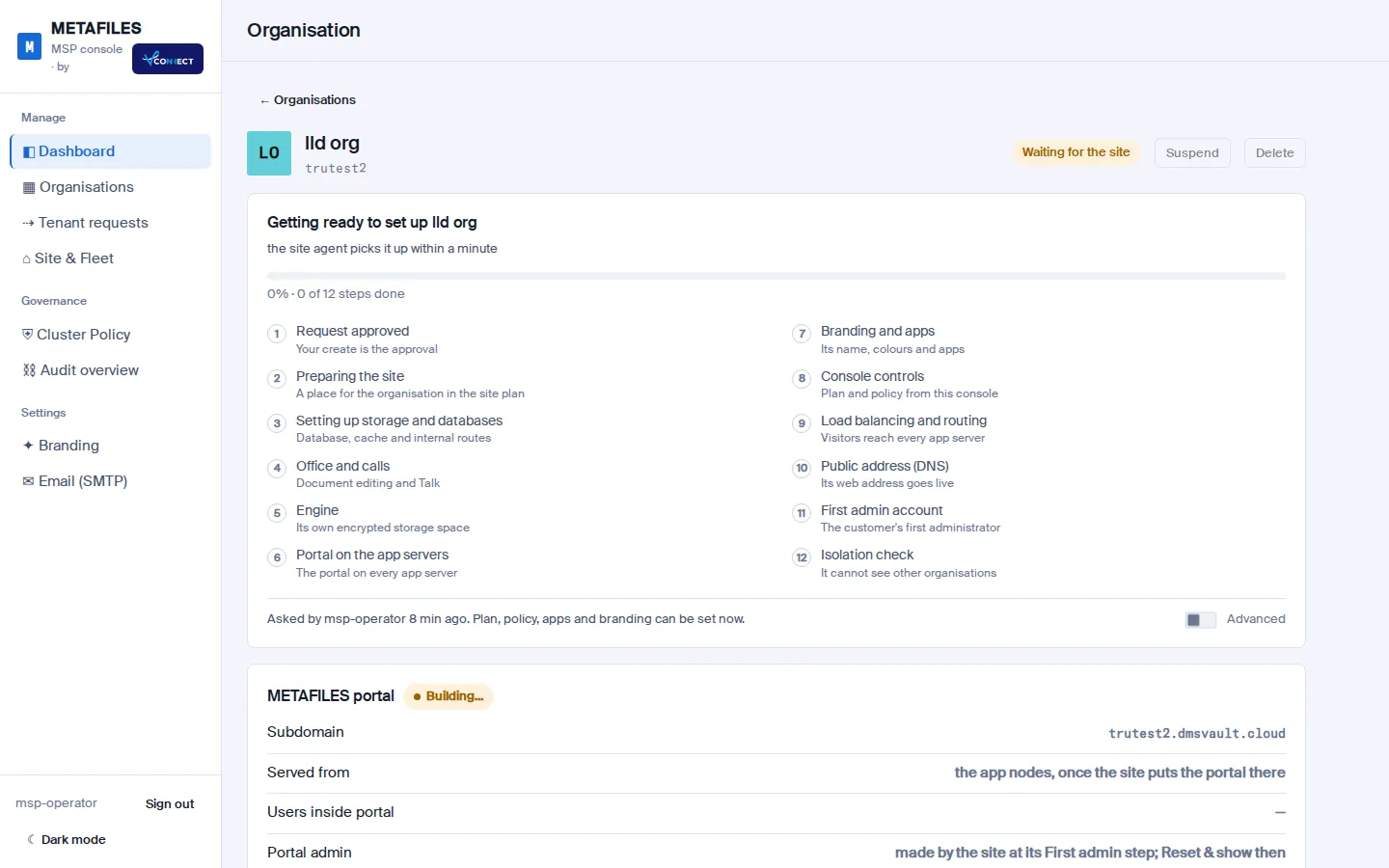
"Can another company see our files?" is the first question every customer asks a shared platform, and the right answer is not a promise. On METAFILES, the last step of building every new organisation is a test suite that tries to cross from one organisation into another, and the organisation is not handed over until it passes.
What each organisation gets of its own
| Layer | Its own |
|---|---|
| Files | Its own encryption key, its own storage area and its own storage credential in the engine |
| Storage target | Optionally a bucket of its own; one bucket never serves two organisations |
| Database | Its own database and database user |
| Cache | Its own cache database and an access-controlled user limited to it |
| Portal | Its own METAFILES portal, which cannot reach the engine's admin interfaces |
| Edge | Its own public address and route, with its own suspended or read-only state |
| Office and Talk | Its own document-editing binding and its own Talk backend secret |
When an organisation is deleted, its ID is retired for good, so a new organisation can never inherit what an old one left behind.
The isolation suite
The suite runs as the twelfth and last step of the build checklist. Each check plays organisation A and tries to reach organisation B:
- Storage gateway: A's key on B's storage, or copying from B into A, is refused.
- Database: A's database user opening B's database is refused.
- Cache: A's cache user reading, scanning, selecting or flushing B's data is refused, command by command.
- Network: from inside A's portal, the engine's admin port and B's portal are unreachable.
- Sign-in: the admin interface does not answer on an organisation's address, and an engine login is bound to its own host.
- Office: A's editing token on B's document host is refused.
- Talk: A's Talk backend credentials for B are refused.
- Federation: sharing from A to B as another server is refused.
Isolation is step 12 of 12 in the build checklist.
When a check fails, the build stops
A failed isolation check is a failed build: the organisation stays in "building", the reason is shown on its page, and the operator fixes the cause and presses Retry, which resumes after the steps already done. In our own testing this is exactly what happened: an early run stopped on the sign-in check because of a control-plane access rule, not a leak between organisations. We fixed the rule and the suite passed. That is the point of running it every time.
Controls that are real
The same thinking applies to the MSP's controls. A setting such as "require two-factor" or "no public upload links" is enforced on the server, in the storage gateway, at the edge or by the policy service that re-applies MSP-locked settings, rather than only shown in a form.
Read more in Tenant isolation and Security.