
Tenant isolation
What each organisation has of its own, how the isolation check proves it on every build, and which shared services are handled with extra care.
Many organisations share one METAFILES site, so keeping them apart is a core job of the platform. This page lists what each organisation has of its own and how isolation is checked.
What each organisation has of its own
| Layer | Of its own |
|---|---|
| Engine data | Its own encrypted space in the engine, its own encryption key and its own storage credential. The engine refuses any request whose credential does not match the organisation it names, and a copy can only read from the caller's own data. |
| Storage target | Optionally, its own bucket in Amazon S3, another S3 service or its own server. One bucket belongs to one organisation only; a bucket used by another organisation, or one that already holds engine data, is refused. |
| Database | Its own database and its own database user. |
| Cache | Its own cache database and its own cache user, limited to that database. |
| Portal | Its own portal on each app server. Portals cannot reach the engine's administration ports. |
| Edge | Its own public address, its own route in the load balancer, and its own access rules (suspended or read-only). |
| Office and Talk | Its own document-editing address and its own Talk secret. |
| Organisation ID | Retired for good when the organisation is deleted, so a new organisation can never inherit an old one's leftovers. |
The isolation check on every build
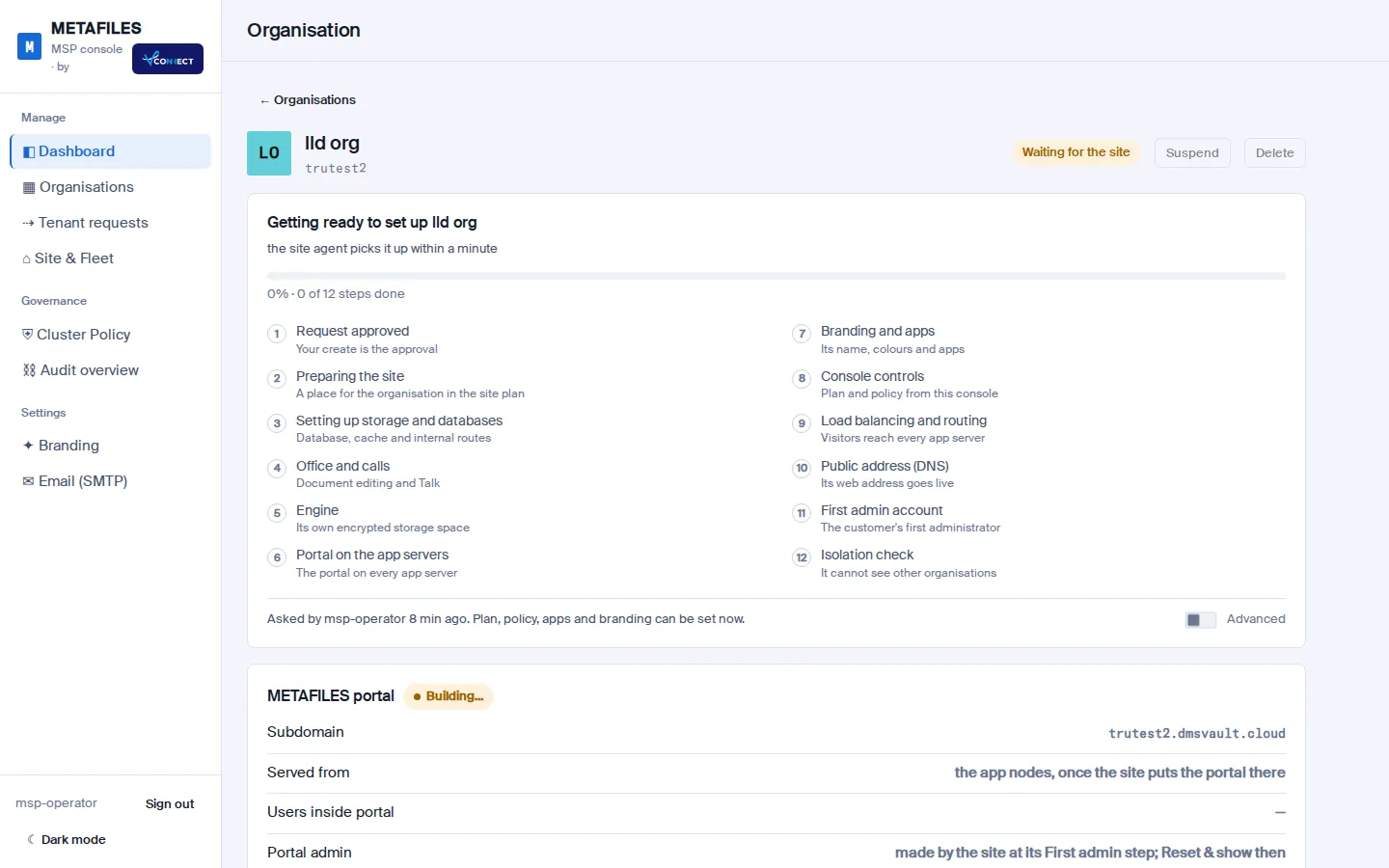
The last of the 12 build steps is an isolation check. A new organisation is not marked as built until it passes. The check tries to cross the line between organisations, and every attempt must be refused:
| Check | What it tries |
|---|---|
| Storage gateway | Using one organisation's storage key on another's data, or copying from another's data |
| Database | One organisation's database user opening another's database |
| Cache | One organisation's cache user reading, scanning, listing, switching to or flushing another's cache data |
| Network | Reaching the engine's administration port or another organisation's portal from inside a portal |
| Sign-in | The engine's administration interface on an organisation's address, and sign-in bound to the right organisation |
| Office | Using one organisation's document-editing token on another's documents |
| Talk | Using one organisation's Talk connection for another |
| Federation | Sharing from one organisation to another |
The checks that compare two organisations run once the site has more than one organisation to compare against.
Shared services, handled with care
Some services serve every organisation by design: document editing, the call services and the storage engine process. Each organisation reaches them only with its own tokens, secrets and keys, and the isolation check tests exactly those boundaries.
The MSP is powerful by design: it can suspend an organisation and change its policy. Every MSP action is named, recorded in the organisation's audit trail and, where it reduces access or history, delayed by an undo window.
Coming: the next generation of the engine gives each organisation keyed chunk identifiers and no deduplication across organisations, and seals file metadata as well as file contents.